Patient Experience Week: Wellness Wednesday—Creating a Culture of Safety and Compassion for Everyone
Spotlight: Creating a Culture of Safety and Compassion—For Everyone
Exceptional care begins with a safe and compassionate environment—for our patients and our staff.
This Patient Experience Week, we’re highlighting two closely connected and essential focus areas: Caregiver Wellness and Trauma-Informed Care. Together, they form the foundation of a culture where healing, compassion, and well-being thrive.
As we reflect on what it means to care for others and each other, we affirm that at Carilion Clinic, every team member—clinical or nonclinical—who wears a Carilion Clinic badge is a caregiver. Each of you plays a vital role in advancing our mission, and together, we are united by a shared commitment to compassion, excellence, and service.
Caring for the Caregivers: Wellness as the Foundation of Exceptional Patient Experience
In healthcare, we’re entrusted with an incredible responsibility—walking alongside people during some of the most vulnerable, life-altering moments they’ll ever experience. It’s a sacred calling, and one that requires immense compassion, skill, and resilience.
We cannot expect our caregivers to pour from an empty cup. Prioritizing caregiver wellness isn’t optional—it’s essential. When our teams feel emotionally supported and physically well, they are more resilient, more engaged, and better able to provide safe, high-quality, compassionate-connected care.
Wellness starts with awareness. Sometimes, a team member may act out of character or react more strongly than expected. Those moments may be signs of emotional fatigue or stress. When we notice them, we can check in—with kindness and without judgment.
At the end of the day, our goal is simple: We want every caregiver to feel like they belong, that their work matters, and that they can bring their full, authentic selves to work.
Wellness That Meets You Where You Are
Caregiver wellness isn’t a luxury. Our patients deserve caregivers who can show up fully, and our caregivers deserve support that helps them do just that.
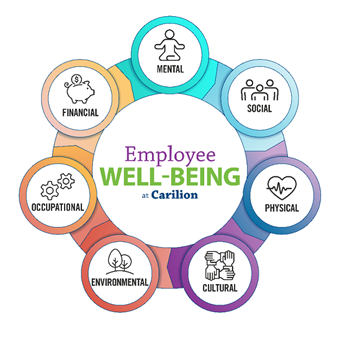
At Carilion, we’re committed to a full-spectrum approach to wellness. Because each person brings their whole self to work, our resources reflect the diverse needs of our teams—across all roles and departments.
- For individuals, we offer tools to support physical, emotional, and mental well-being—accessible anytime, anywhere.
- For teams, we host workshops, pop-up activities, and comfort experiences that build connection, resilience, and even joy.
- Organizationally, we are constantly working to improve systems, policies, and environments so that caregivers can thrive in their work.
From drop-in activities like painting workshops and live music to the Compassion Cart rounding through units, from the Personify Health platform to auricular acupressure for trauma recovery, we are here to make wellness real, accessible, and impactful. Recently we launched a Check You, Check Two initiative focusing on the awareness of individual and peer stress levels and offering support. We encourage all caregivers to check it out, and to visit the Well-being Hub on Inside Carilion to learn about all the wellness programs we offer.
Real Impact, Measurable Change
Well-being is not just a feel-good initiative—it drives meaningful outcomes. Among Carilion employees who engage with our digital wellness platform:
- 78% of those at high risk for hypertension have reduced their blood pressure
- 63% of inactive individuals are now moving more
- 79% of high-risk participants have lost weight
- And we’ve seen a 10% lower attrition rate among engaged employees
Since January 2025, our team has collectively lost over 3,000 pounds through WeightWatchers alone. Behind every number is a story of renewed energy, better health, and reclaimed confidence.
Moments That Matter
While we celebrate the fun and joy our team brings to units, some of the most unforgettable moments come in the quietest places—offering healing after trauma, peace after chaos.
One caregiver, struggling with self-doubt after a difficult experience, received acupressure support. She told us it was the first time she had felt calm in over two weeks. Her body softened, her breath slowed. We saw relief take shape in real time.
That is the power of presence. That is the heart of wellness.
Leaders Who Lead by Example
Model the Behavior: Wellness starts at the top. When leaders model balance—taking breaks, setting boundaries, using their PTO—they give their teams permission to do the same. When leaders walk the walk, it signals to teams that wellness is not just encouraged—it’s expected. Leadership that supports wellness creates cultures where:
- Creativity can flourish
- Innovation becomes possible
- People feel safe, seen, and valued
If there’s one truth we’ve seen again and again, it’s this: you cannot create extraordinary patient experiences without supporting the people who deliver them.
Your Wellness Tools: Practical Tips for Every Day
1. Prioritize Yourself
Even small acts of self-care matter. Move your body, eat well, rest intentionally—not just out of duty, but as a declaration of worth.
2. Set Boundaries
Protect your time and energy. Boundaries are not barriers—they’re bridges to sustainability.
3. Seek Support
You’re human, not a superhero. Connect with someone who can listen without judgment. Ask for help. You are not alone.
Daily habits that build resilience:
- Start a “best moments” journal or gratitude list
- Practice positive self-talk—speak to yourself with kindness
- Invest in relationships that fuel you, not drain you
Wellness Is Not One More Task. It’s the Ground You Stand On.
This Patient Experience Week, we celebrate you—the caregivers who show up, lift up, and hold up others every single day. You are the heartbeat of our organization. And your wellness is not a side note—it’s central to the healing we provide.
Thank you for all you do.
Thank you for how deeply you care.
And thank you for letting us care for you in return.
Trauma-Informed Care: A Shift in Perspective
Every person who walks through our doors carries a story—often one shaped by stress, pain, or past trauma. Trauma-Informed Care asks us to acknowledge that reality and to reframe how we see and respond to others. It starts with a simple but powerful question:
“What’s happened to this person?” instead of “What’s wrong with them?”
When another person is behaving in a way that seems “difficult,” “inappropriate,” “disengaged” or “aggressive” we need to pause and ask ourselves, “What is happening to them?” Emotional dysregulation is a sign that they are not giving us a hard time, they are having a hard time. That one change in perspective can help us respond with curiosity and empathy rather than judgment or defensiveness. The four principles of trauma informed care are to promote safety, empathy, empowerment, and support.
Patients don’t come to us because they’re at their best—they come to us when they are unwell, afraid, or in pain. To feel safe enough to learn, to understand, and to make decisions about their health, they must first feel seen, cared for, and heard. Trauma-Informed Care helps build that foundation. We often say, “the patient is at the center of everything we do.” And that is true. But it’s important to remember that the patient is a complex human being with robust lived experience. Honoring that uniqueness and responding with curiosity and compassion has an outsized impact on their experience. This is exemplified in our patient comments:
“I had anxiety about the procedure but everyone from receptionists to nurses to doctors explained each process and bent over backwards to help me through this. I really appreciated everyone's hard work and the respect they showed me and my concerns.”
“My husband couldn't make it in time for our emergent c-section so the OR nurses held me for my spinal anesthesia. Each and every nurse during my c-section made it bearable since they knew my husband would miss it. Their compassion and empathy made an enormous difference for me during one of the scariest times of my life. The OR, PACU, mother/baby, and NICU nurses are absolute angels.”
“The dr. who helped me did exceptional to take care of me. I never knew an abscess could be so painful and all the staff seemed to understand this. Plus, this is a difficult time in my life emotionally and they helped me feel like a real person. I'm at a point in my life where I feel like most of the world looks at me like I'm worthless. But, nobody there seemed to notice my social status, and instead treated me like I was a real person, someone valuable and cared about. That means more to me than any other question asked on this survey. The staff couldn't fake something like this. They genuinely care about what they do, care about the patients, and want to help. Thank you.”
“Great experience. My daughter is autistic and it is very difficult to diagnose or treat her. The ED physician, nurses and Rad Techs treated her with respect and patience which Is not usually the case when she has medical appointments. They took their time with her and she liked them. Kudos to the staff for the respect and treatment we received. Much appreciated.”
“The nurses were so kind and compassionate as I gave birth to our son, who was stillborn. They were prompt in response to my pain and very caring when giving us time with our son. They made sure we got pictures and imprints of his feet. They found blankets and a hat to fit his very small body. We were blown away with how above and beyond they all went to care for us on a really hard day.”
“I was thoroughly impressed by the level of care and professionalism of my doctor. He listened to me first....for as long as I needed. He was very familiar with my chart and history. He spoke highly of the care I had been given by other health care professionals. He was respectful. He exuded confidence. I was afraid when I came In....afraid because I have been sick for a long time and am still awaiting answers....he gave me confidence that I would soon have answers and that I had been receiving proper care. He eased my anxiety and fears and made me feel much better about what lay ahead for me. I was thankful that I had received services from him.”
“The health care workers here are heroes. They all have made a huge impact on my life. Suzane Wells is an incredible nurse who is so caring and showed me love and hope. Grace is going to make an incredible doctor. She is so strong and an amazing lady. Joi is so amazing she pours out so much life and joy to her patients. Bri is so awesome and I really enjoyed hanging out and talking to her. And so much more, everyone here is a hero. The care providers here are so amazing. They get up every day and pour out their heart into the patients and show them so much love. I will forever be grateful for healthcare workers. Also the Radford nursing students were so kind and provided me so much happiness and confidence. I'll never forget this place. I love each and everyone of the staff here. Thank you Dr. Rah for knowing and recognizing I need to heal and believing in me. You are an amazing doctor and I'll forever be grateful for your time and the care you have shown me. Also, I want to thank Grace again. I'll never forget her reassurance and persistence that showed me I can get better and it's okay to get help. Thank you so much.”
The same is true for our staff. Healthcare is complex, emotionally demanding work. Every day, our teams face high stakes and high stress. To show up with empathy and presence for our patients, we must also create a workplace where our caregivers feel safe, valued and supported.
Yet we know this approach isn’t always easy. In fast-paced clinical environments, slowing down to be fully present can be a challenge. But even brief, intentional moments—eye contact, a gentle tone, asking one more question—can transform an interaction.
It’s also about mindset. When someone seems “difficult” or “disengaged,” trauma-informed care reminds us: They’re not giving us a hard time—they’re having a hard time. That perspective shift invites empathy, not judgment.
Through department trainings, shared stories, and leadership support we’re weaving trauma-informed principles into everyday care—one connection at a time.
As Lisa Dishner, Senior Director of Carilion Mental Health, explains:
“Trauma-informed care approaches are essential to fostering meaningful connections between patients and staff. In fact, I would go so far as to say that trauma-informed principles should serve as the foundation for all of our standards—both for patients and for staff. When individuals are able to show up as their whole selves, feel heard, and connect on a personal level, the potential for positive outcomes increases dramatically.”
Lisa and her team consistently apply these principles in their daily patient care.
“For both our teams and our patients, connection is vital. We strive to avoid power struggles and instead engage with our patients as individuals. By proactively identifying potential triggers and adapting our responses with the understanding that each person is unique, we’ve been able to significantly reduce the use of restraints. These strategies enable us to focus on de-escalation and build trust through genuine connection.”
Actions for Wellness Wednesday:
- Check In with a Colleague: Today, ask a teammate: “How are you really doing?” Not in passing, but with presence. Sometimes, knowing someone cares is the most powerful wellness tool of all.
- Take 10 for You: Block off 10 minutes on your schedule today to do something just for you—a quick walk, a stretch, deep breaths, or even listening to a favorite song. Small moments of care for yourself add up.
- Practice a Trauma-Informed Pause: When a patient or peer seems upset, take a moment to ask yourself: “What might they be going through?” Then respond with curiosity instead of assumption. This simple pause can shift the entire tone of the interaction.
Learn More
Visit the Patient Experience Hub on Inside Carilion.
Visit the Well-being Hub on Inside Carilion.
Check the Wow Wall each day this week for more Patient Experience content:
- Mission Monday—Reflect on the Why Behind What We Do
- Teamwork Tuesday—Celebrating Collaboration
- Wellness Wednesday—Creating a Culture of Safety and Compassion for Everyone
- Thankful Thursday—Gratitude in Action
- Forward Friday—Looking Ahead with Purpose