Building the Next Version of Carilion: Steve Arner on the Next 5 Years
Carilion Clinic President and CEO Steve Arner took on Carilion's top leadership role after several decades of experience across our organization. His previous roles at Carilion include financial analyst,budget manager, Human Resources compensation and analytics director, hospital administrator at CRBH, senior vice president of Cardiothoracic and Vascular Services, and chief operations officer.
Chief of Staff Chris Turnbull sat down with Steve for a conversation about Carilion's future and what front-line staff can expect.
This is Part 3 in a 3-part series.
- Read Part 1: "Most Things Can Wait"—Steve Arner on Clarity, Curiosity and Leadership Under Pressure.
- Read Part 2: 'Operating Model Redesign'—Steve Arner on Making Carilion Easier for Patients and Teams
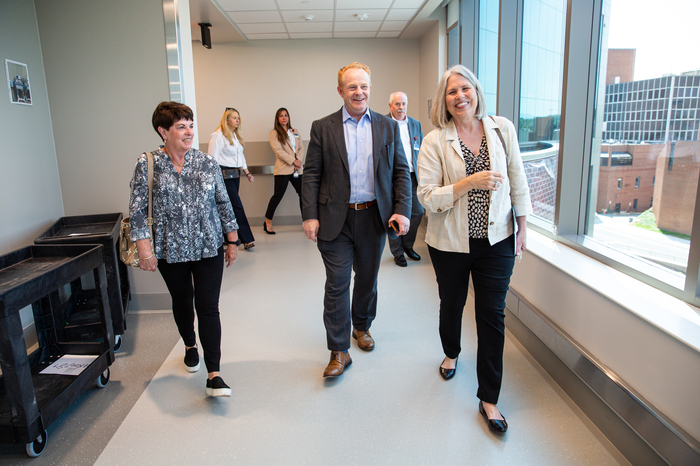
Above: Steve Arner visits the Crystal Spring Tower.
Chris Turnbull: Steve, in our last conversation you talked about building Carilion’s next operating system. What does that mean to you?
Steve Arner: It means building something durable.
Health care is changing quickly. Reimbursement pressure, workforce dynamics, demographic change, technology, patient expectations—all of those forces are real. We cannot respond to them with short-term fixes alone.
We need an organization that can perform consistently in a changing environment. That requires structure, discipline and adaptability.
Chris: Some people may hear “operating system” and think of technology. But you mean something broader.
Steve: Much broader.
Technology is part of it, but the operating system is really how the organization works. How decisions are made. How information moves. How teams coordinate. How priorities are set. How we measure performance. How we solve problems.
If that system is unclear, everything gets harder. If it is strong, people can move with more confidence.
Chris: What does success look like 5 years from now?
Steve: I would like Carilion to be easier to access, easier to work in and more reliable in how we perform.
I would like patients to experience less friction. I would like employees to spend more of their energy on meaningful work and less on navigating complexity. I would like leaders to have clearer accountability and better information. I would like us to be financially strong enough to keep investing in our mission.
That is not one project. It is a sustained body of work.
Chris: You’ve said Carilion needs to “get the system right” before growth. Why is that important?
Steve: Because growth without discipline can create more complexity.
We should grow where growth helps us serve the community and strengthen the organization. But we have to be honest about whether we are ready to absorb that growth well. If the underlying system is fragile, expansion can make the work harder.
Sustainable growth depends on a strong core. Sometimes this means partnering with other organizations who can help us perform better, move faster or bring capabilities we do not have at the same level. For example, we have partnered with Ensemble for revenue cycle and are partnering with Select Healthcare for our future inpatient rehab hospital.
No matter what, we should always ask what is best for patients, employees and the community. If a different model improves performance, access, quality or sustainability, we owe it to the organization to consider it.
Chris: You’ve been described as someone who speaks later in meetings than people might expect. Is that intentional?
Steve: When you’re in the CEO role, your voice can carry more weight than you intend. If I speak too early, I can anchor the discussion before the team has had a chance to work through the issue. I don’t want that.
I want teams to test ideas, challenge assumptions and explore options. Then I can engage in a way that hopefully sharpens the thinking rather than narrowing it too soon.
Chris: What should our front-line teams expect for the next few years?
Steve: Change is going to be part of our work. But I don’t want people to hear that as change for its own sake.
The purpose is not disruption. The purpose is improvement. We are trying to reduce friction, strengthen performance and make Carilion more capable of serving the region for the long term.
Some changes will be visible. Others will be behind the scenes. But the goal is consistent: build a system that supports people better.
Chris: Final question. What is your outlook for our organization?
Steve: I am optimistic. Not because the work is easy. It isn’t. But because Carilion has the people, the mission and the community connection to build something stronger.
I care deeply about this organization and the people in it. When I ask questions, it is because I am trying to understand the system well enough to improve it. When the system makes caring for our patients and communities harder, we have to change the system.
We are here to care for people. Everything else should support that.
