'Most Things Can Wait'—Steve Arner on Clarity, Curiosity and Leadership Under Pressure
Carilion Clinic President and CEO Steve Arner took on Carilion's top leadership role after several decades of experience across our organization. His previous roles at Carilion include financial analyst,budget manager, Human Resources compensation and analytics director, hospital administrator at CRBH, senior vice president of Cardiothoracic and Vascular Services, and chief operations officer.
Chief of Staff Chris Turnbull sat down with Steve for a conversation about curiosity, decision-making, and Steve's leadership style. Read their conversation below.
This is Part 1 in a 3-part series—check back next week for Part 2.
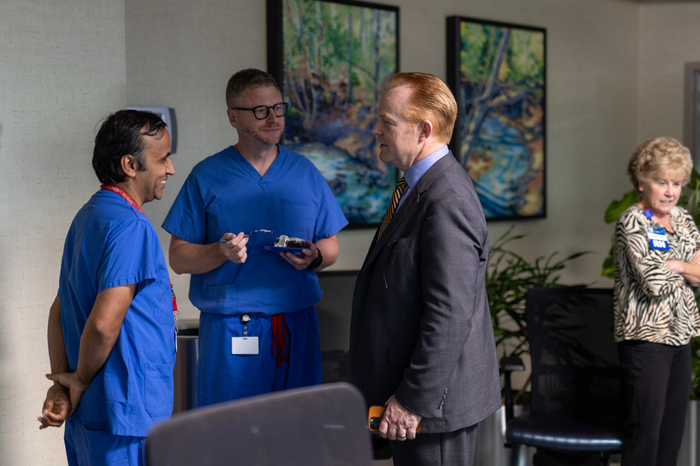
Above: Steve Arner talks with clinicians at CRMH.
Chris Turnbull: Steve, people who work with you often hear you say, “Most things can wait.” In health care, that can sound almost counterintuitive. What do you mean by it?
Steve Arner: I don’t mean patients can wait. I don’t mean safety can wait. I don’t mean quality can wait. Those things require immediate attention.
What I mean is that not every issue benefits from an immediate reaction. In a complex organization, urgency can become a habit. Everything gets escalated. Everything feels like it needs a decision right now. But if we treat every issue as equally urgent, we can make rushed decisions that don’t solve the real problem.
Sometimes the most important thing a leader can do is pause long enough to understand what is actually happening.
Chris: That sounds like discipline, not delay.
Steve: That’s right. Pausing is not the same as avoiding. It’s about getting enough clarity to act well.
In health care, we are surrounded by real urgency. That makes it even more important to know the difference between a true emergency and something that feels urgent because of pressure, emotion, or habit. If something affects patient safety, access or our ability to care for people, we need to move. But we still need to move thoughtfully.
Chris: You are known for gathering information before making a decision. What does that look like in practice?
Steve: I ask a lot of questions. Sometimes I’ll ask for a data cut or a comparison that may seem small. But I’m usually trying to understand the shape of the issue.
Numbers matter, but they’re not enough. I also want to know what something feels like to the people closest to the work. A process may look logical on paper and still be frustrating for a nurse, a physician, a registration colleague or a patient. We have to understand both.
Chris: So the question is not just, “Is this decision technically correct?” It’s also, “How does this decision land where care happens?”
Steve: Exactly. We can design something that looks efficient from the center but creates friction on the front line. That’s not success. We have to get better at seeing the full system.
Chris: How do you decide which problems are worth tackling first?
Steve: I look for problems that affect patients, employees and performance at the same time. Those are usually signals that the system needs attention.
For example, if a process is frustrating for employees, confusing for patients and financially inefficient, that is not three separate problems. That is one system problem showing up in three ways.
Chris: That connects to another trait people associate with you: curiosity. You read widely, you pull ideas from other industries, and you ask questions that sometimes take the conversation in unexpected directions.
Steve: I like understanding how things work. I especially like understanding why something works the way it does when everyone has stopped asking the question.
In organizations, a lot of processes continue because they are familiar. Someone created them for a reason, but the reason may no longer apply. Curiosity helps you find those places.
Health care has unique responsibilities, but not every problem we face is unique to health care. Other industries have dealt with complexity, reliability, supply chains, customer experience, technology adoption, and workforce redesign. We should be humble enough to learn from them.
Chris: You often share summaries of what you’re reading with senior leaders. What are you trying to create with that habit?
Steve: Shared learning. Leadership teams can get consumed by immediate operational issues. That’s understandable. But we also need to look up and around.
When I share something I’m reading, I’m not saying, “Here is the answer.” I’m usually saying, “Here is something worth thinking about.”
Chris: What role should curiosity play for employees who are not in formal leadership roles?
Steve: A huge role. Some of the best insights in this organization come from people who see the work directly.
If you notice that something is harder than it needs to be, that matters. If you see a workaround that everyone accepts as normal, that may be a clue. If you wonder why two teams do the same work in different ways, ask.
Curiosity is not reserved for executives. In fact, it is more powerful when it is distributed.
Chris: What would you encourage people to do with that curiosity?
Steve: Pair it with ownership. Don’t just say, “This is broken.” Help us understand what is broken, why it matters and what might make it better.
We need people who are willing to question assumptions constructively. That is how systems improve.
Chris: So curiosity is not about criticism. It is about possibility.
Steve: Exactly. It is about believing we can make the work better—for patients, for families, for employees and for the communities we serve.
I believe Carilion's future depends on our ability to think clearly, make disciplined decisions and reduce unnecessary complexity to our patients and our teams. That takes urgency in the right places and patience in the right places.
Chris: It sounds like you view patience as different from passivity?
Steve: No. Patience can be very active. It can mean looking harder, asking better questions and refusing to accept the first explanation when the real issue is deeper.
Most things can wait. But the things that truly matter—safety, access, trust, our mission—those deserve our best thinking and our best action.
