'Operating Model Redesign'—Steve Arner on Making Carilion Easier for Patients and Teams
Carilion Clinic President and CEO Steve Arner took on Carilion's top leadership role after several decades of experience across our organization. His previous roles at Carilion include financial analyst,budget manager, Human Resources compensation and analytics director, hospital administrator at CRBH, senior vice president of Cardiothoracic and Vascular Services, and chief operations officer.
Chief of Staff Chris Turnbull sat down with Steve for a conversation about system-ness and how his previous job experience provides insight.
This is Part 2 in a 3-part series.
- Read Part 1: "Most Things Can Wait"—Steve Arner on Clarity, Curiosity and Leadership Under Pressure.
- Check back next week for Part 3.
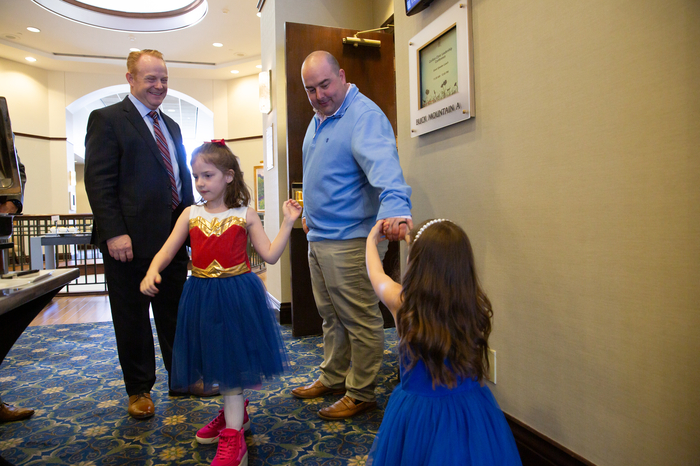
Above: Steve Arner talks with the family of pediatric patient Aubrey Scaletta.
Chris Turnbull: Steve, one phrase you often say is, “It shouldn’t be this hard.” What are you usually thinking about when you say that?
Steve Arner: I’m usually thinking about friction.
It shouldn’t be this hard for a patient to access care. It shouldn’t be this hard for an employee to do their job. It shouldn’t be this hard for a leader to get the information needed to make a good decision. It shouldn’t be this hard for a system to operate like a system.
That phrase is a way of naming something we all experience. People across Carilion work incredibly hard. But sometimes they are working hard around the system instead of being supported by the system.
Chris: You’ve spent much of your career inside Carilion, in very different roles—finance, human resources, hospital administration, service lines, and operations. How has that shaped what you notice?
Steve: It has given me an appreciation for how complicated this organization is and how much good work happens every day despite that complexity.
Carilion did not become what it is today all at once. Like many health systems, we evolved over time. Hospitals, practices, service lines, partnerships, technology, regulations—they all accumulated. That history matters. But it also means we have variation in how work gets done.
Some variation is appropriate. Local context matters. But some variation creates confusion, delay and cost. We need to be honest about the difference.
Chris: Before becoming President and CEO, one of your early leadership experiences was at CRBH. What did that teach you?
Steve: Rockbridge was an important experience for me.
Early in my career, I had the opportunity to help lead the turnaround of Carilion Rockbridge Community Hospital. It was a difficult situation. The hospital was losing a significant amount of money, and there was not a large margin for error.
That kind of experience teaches you quickly. You have to understand operations, finance, people, community expectations, and clinical realities all at once.
Chris: What did it teach you about leadership?
Steve: It taught me that leadership has consequences.
When you’re working in a smaller community hospital, decisions feel very close. You see the impact on employees. You see the impact on patients. You understand that the hospital is not just a facility. It is part of the community’s identity and security.
It also taught me that financial performance and mission are not separate. If we’re not financially strong, we can’t invest in care, people or access. Stewardship is part of the mission.
Chris: You’ve also had roles that exposed you to very different parts of the organization — finance, HR, cardiovascular services, surgical services, hospital operations. How does that variety shape your view from the CEO seat?
Steve: It helps me see connections.
A decision in one area often creates pressure somewhere else. A staffing decision affects access. A technology decision affects workflow. A revenue cycle decision affects financial strength and patient experience. A facility decision affects care delivery.
When you have worked across different areas, you become more aware that the organization is one system, even when it does not always behave like one.
Chris: You have said that at one point you wondered whether you were delivering enough value to justify your compensation, and that helped push you toward earning an MBA. Why did that matter?
Steve: I felt a responsibility to be better prepared.
I don’t think leadership is something you’re entitled to. You have to earn it. You earn it by creating value, by helping people succeed, by making better decisions and by continuing to learn.
That realization pushed me to build skills I didn’t yet have. It also stayed with me. I still believe leaders have to ask themselves whether they are delivering enough value for the trust placed in them.
Chris: That is a pretty demanding standard.
Steve: It should be. Health care is too important for casual leadership.
People depend on this organization in very real ways. Patients depend on us. Communities depend on us. Employees build their lives around this work. That should make us serious about performance.
Chris: At times you have referred to “operating model redesign” or “building the next operating system” for Carilion Clinic. What does that mean in plain language?
Steve: It means we have to make Carilion easier to work in and easier to receive care from.
That includes how decisions get made, where authority sits, how teams coordinate, how information moves, and how we reduce duplication. The goal is not bureaucracy. The goal is clarity.
A strong operating system helps people know where to go, who decides, what standard work looks like and how to solve problems. It should make the right thing easier to do.
Chris: You often talk about Carilion behaving more like a system. What does that look like for our teams?
Steve: Ideally, it looks like fewer workarounds.
It looks like a patient getting a more consistent experience, regardless of where they enter Carilion. It looks like employees spending less time hunting for answers. It looks like leaders having cleaner information. It looks like teams being able to focus more energy on care and less energy on navigating internal complexity.
We will not get there overnight. But we have to move in that direction.
Chris: What do you say to people who worry that standardization means losing local judgment?
Steve: That’s a fair concern. Standardization done poorly can become rigid. That’s not what we need.
We need consistency where consistency improves safety, access, reliability and experience. But we also need room for local insight. The people closest to the work often understand the practical realities better than anyone else.
The question is not, “Should everything be the same?”
The question is, “Where does variation help, and where does it hurt?”
Chris: What role do our front-line teams play in that?
Steve: A central role.
The people closest to the work know where the friction is. They know which processes make sense and which ones don’t. They know where patients struggle. They know where handoffs fail. They know where we are making work harder than it needs to be.
We need that insight.
