Q&A with Steve Arner: New Year’s Eve 1999, Casual Leadership, and Hard Processes
Carilion Clinic President and CEO Steve Arner has held a variety of roles across Carilion, including in finance, Human Resources, hospital administration, service line leadership, and operations. In this first installment of a wide-ranging interview, Chief of Staff Chris Turnbull talks with Steve about how those experiences shaped his view of leadership, performance, and responsibility.
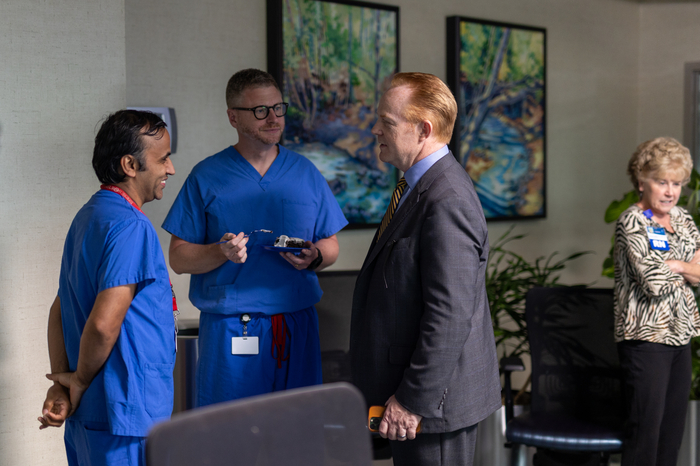
Above: Steve Arner talks with clinicians at CRMH.
Chris Turnbull: Steve, this may sound like an odd question since you’ve spent 30 years working in healthcare now, but did you always want to work in this field?
Steve Arner: I’ve always been around healthcare. My father was an OB/GYN ... he actually worked at Carilion from the mid 90s to 2010. He was an Army doctor when I was growing up, and I have fond memories of visiting him at the hospital when he was on shift. We’d always find a place in the cafeteria to have a meal. Those experiences built a lot of respect for his work and everyone he worked with.
My wife Brenda and I moved to Roanoke in 1996 because we planned to go to law school in Virginia. While we were establishing ourselves, I was encouraged to apply for a position at Carilion. My dad really liked it here and so I applied and was thrilled to get a job in the newly formed Corporate Finance department.
It wasn’t until three years later that I really knew I wanted to devote my career to supporting healthcare providers. Our second son, Jared, was in the NICU at Roanoke Community Hospital for three weeks. I remember Brenda and I camped out in the NICU on Dec. 31, 1999, waiting to see if all the systems would work properly when the computers switched over to the year 2000.
It was a scary moment as parents. And I was in awe of the nurses and doctors (and many others) who cared for Jared and all the other tiny patients. They made my family their priority. That stuck with me. Still does.
Unfortunately, a couple months later we were back at Community Hospital in the Emergency Department when Jared was admitted to the PICU with spinal meningitis. It was another incredibly scary experience, but the pediatric intensivists and nurses were amazing.
Chris: Sounds like that team really made an impression on you and your family.
Steve: There’s no question. Their care and concern, their dedication to my son and Brenda and me connected a lot of dots in my head about our mission and my role in it. Come to think of it, I doubt that team would have even known they had that impact. They’d probably say they were “just doing their jobs” that day. It’s a great reminder of the impact all of us can have on others. Most of the time we probably won’t ever know.
Chris: And the rest is history. You’ve spent much of your career inside Carilion, in various roles—finance, human resources, hospital administration, service lines, and operations. And on top of that, you also worked for one of the country’s largest health insurers. How have those experiences shaped what you notice?
Steve Arner: They have given me an appreciation for how complicated our organization is and how much good work happens every day despite that complexity.
Carilion did not become what it is today all at once. Like many health systems, we evolved over time. Hospitals, practices, service lines, partnerships, technology, regulations—they all accumulated. That history matters. But it also means we have variation in how work gets done.
Some variation is appropriate. Local context matters. Other variation creates confusion, delay, and cost. We need to be honest about the difference.
Going back to my story about Jared for a moment: It happened 26 years ago, and yet I still remember how difficult it was for me to navigate our system when we brought him to the Emergency Department. At the time, our process was broken. When the pediatric critical care physician Dr. Kayrouz came in, he took one look at Jared and immediately knew something wasn’t right. I’ll be forever grateful for his quick action.
Jared’s experience is one reason I’m so passionate about improving and standardizing our processes, and why it’s so important to listen to the families of our patients.

Chris: Before becoming President and CEO, one of your early leadership experiences was at Carilion Rockbridge Community Hospital. What did that teach you?
Steve: Serving the Rockbridge community was an important experience for me.
I had the opportunity to help lead the financial turnaround of our hospital there. It was a difficult situation. The hospital was losing a significant amount of money each month. The team at CRBH was (and is) incredibly dedicated, and together we developed a plan to ensure we could deliver healthcare for decades to come.
That kind of experience teaches you quickly. You have to understand operations, finance, people, community expectations, and clinical realities all at once.
Chris: What did it teach you about leadership?
Steve: It taught me how consequential leadership can be.
When you’re working in a critical access hospital, decisions are very close. You see the impact on employees. You see the impact on patients. You understand that the hospital is not just a facility. It is part of the community’s identity and security. I knew the only way out of the situation was teamwork. And the CRBH team was (and is!) amazing.
It also gave me even more clarity about our mission. Our mission is why we are here: to improve the health of the communities we serve, care for our patients, and support the people who make that care possible. Financial strength is not the goal; it gives us the capacity to live that mission more fully, today and for generations to come.
Chris: You told me that, at one point early in your career, you wondered whether you were delivering enough value and that helped push you toward earning an MBA. My guess is that most people don’t think that way. What’s behind that?
Steve: I felt a responsibility to be better prepared than I was.
I don’t think leadership is something you’re entitled to. It’s earned. And I felt like the only way I could earn it was by creating value, by helping people succeed—reducing friction, for instance—by making better decisions and by continuing to learn.
That realization pushed me to build skills I didn’t yet have. It also stayed with me. I still ask myself every day whether I am delivering enough value for the trust placed in me.
Chris: That is a pretty demanding standard.
Steve: Maybe. I think healthcare is too important for casual leadership.
People depend on this organization in very real ways. Patients depend on us. Communities depend on us. Employees build their lives around this work. As a leader, that makes me take our performance seriously.

Chris: How does the variety of your career experiences shape your view from the CEO seat?
Steve: It helps me see connections.
A decision in one area often creates pressure somewhere else. A staffing decision affects access. A technology decision affects workflow. A revenue cycle decision affects financial strength and patient experience. A facility decision affects care delivery.
I’ve learned it’s easy to make a process hard. It’s easy to just add a policy and think you can manage by policy, for instance. It’s hard to make a process easy. That may be hard work, but for me, it’s the most enjoyable work: Solving the puzzle to make processes easier for our team and for our patients.
As I worked across different areas, I became more aware that the organization is one system, even when it does not always behave like one. I love the moment in a meeting or a discussion, when one of our colleagues asked another, “How would this decision impact you?” That shows great self-awareness—and great curiosity.