A success story: 10 Mountain ICU’s prevention of central line-associated bloodstream infection (CLABSI)
Central line-associated bloodstream infection (CLABSI) is a common hospital-acquired infection that contributes to patient morbidity, mortality, increased patient length of stay, and hospital cost (1,2). CLABSI rates have dramatically increased in the United States because of the COVID-19 pandemic. There has been speculation that a redirection of infection prevention work to focus on COVID-19 during the pandemic led to these national increases in CLABSI(3).
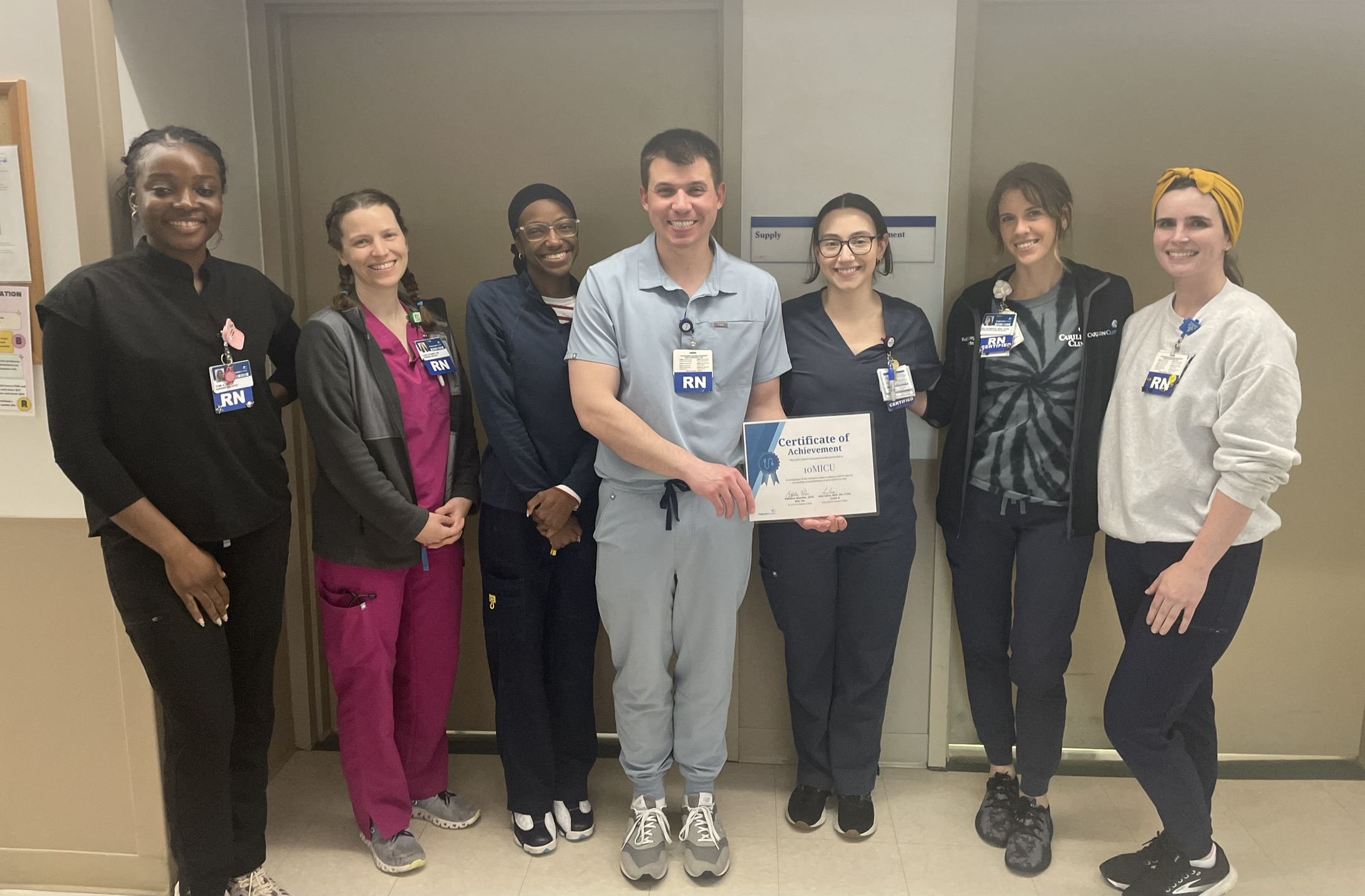
This is not true for the Carilion Roanoke Memorial Hospital’s medical/surgical intensive care unit, 10 Mountain ICU. In fact, this unit has not seen a CLABSI since July of 2020. That is 4 years, 3 months, and 18 days to be exact. This places the unit in the top 10% of all medical/surgical ICUs in the country. This statistically significant finding means that they have prevented eight potentially life-threatening infections during this timeframe (4).
Unit Director, Carla Bapst, BSN, RN, CCRN, credits her team’s success to a comprehensive understanding of and adherence to current evidence-based practice guidelines (5). Examples include:
- Reviewing the clinical necessity for line prior to insertion and daily when line is present.
- Reduction of possible procedural mistakes at insertion with a dedicated central line supply cart and utilization of ultrasound guidance
- Education and reinforcement of daily maintenance practices through patient rounding and addressing gaps in real time with front-line providers.
- Chlorhexidine bathing (treatment)
- Assessment of dressings, alcohol impregnated caps, tubing dating/exchanges
- Optimizing blood culture use and keen attention to specimen management (6) (i.e. aseptic collection, adequate blood volume, and avoiding line draws)
We celebrate Carla and the entire team of healthcare workers on 10 Mountain ICU who collaborate and cooperate to establish this patient safety culture which is resulting in such positive patient outcomes.
References:
1. Bloodstream infection event (central-line–associated bloodstream infection and non–central-line–associated bloodstream infection). Centers for Disease Control and Prevention website. https://www.cdc.gov/nhsn/pdfs/pscmanual/4psc_clabscurrent.pdf. Updated 2019. Accessed 10/21/2024.
2. Hospital-acquired condition reduction program. Centers for Medicare and Medicaid Services website. https://www.cms.gov/Medicare/Medicare-Fee-for-Service-Payment/AcuteInpatientPPS/HAC-Reduction-Program. Accessed 10/21/2024.
3. Stevens MP, Doll M, Pryor R, Godbout E, Cooper K, Bearman G. Impact of COVID-19 on traditional healthcare-associated infection prevention efforts. Infect Control Hosp Epidemiol 2020;41:946–947. [DOI] [PMC free article] [PubMed] [Google Scholar]
4. 1. National Healthcare Safety Network (8/2020 - 10/2024)
5. Strategies to prevent central line-associated bloodstream infections in acute-care hospitals: 2022 Update. Buetti N, Marschall J, Drees M, et al. Infect Control Hosp Epidemiol. 2022;43:553–569. - PMC - PubMed
6. Fabre V, Carroll KC, Cosgrove SE. 2022. Blood culture utilization in the hospital setting: a call for diagnostic stewardship. J Clin Microbiol 60:e0100521. doi: 10.1128/JCM.01005-21 [DOI] [PMC free article] [PubMed] [Google Scholar]
