Carilion History: The Burrell Hospital in Roanoke
At the turn of the 20th century, Roanoke was a young, industrial town crowded with laborers who had come to work for the Norfolk and Western Railway. It was a time when medical advances were just coming to the Roanoke Valley. It was also a time of two distinct societies separated by skin color. One thing the African-American community did not have was adequate healthcare.
A COMMUNITY NEED
The first recorded major surgical operation by Black doctors in southwest Virginia was performed on Nov. 5, 1913. The operation, described as a major abdominal procedure, was performed in a home in Roanoke.
In 1914, a group of African American doctors created the Medley Hospital in a house with 12 beds. Patient flow increased quickly and the doctors bought and renovated a wooden two-story house, creating the not-for-profit Burrell Memorial Hospital Association to care for the Black community.
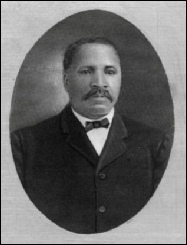
Issac David Burrell, M.D., Roanoke's pioneering African-American physician.
The Association was named for Issac David Burrell, M.D., who founded a pharmacy in Roanoke and was thought by many to be the leading Black doctor in the area. He received his medical degree from Shaw University in 1893 and began practicing medicine in Roanoke.
But before the new hospital could open in 1915, Burrell himself was forced to travel to Washington, D.C. in the baggage car of a train to treat severe gallstones, and he died there.
CREATING A HOSPITAL
The Burrell Memorial Hospital had many modern conveniences of the time. The first floor of the hospital included a minor operating room, spacious reception room, linen and supply closets, a kitchen and steam heating. The second floor housed three wards, the main operating room, a bathroom and nursing quarters.
Lylburn C. Downing, M.D., who was the first African-American physician accepted as a member of the Roanoke Medical Society, was chosen as the hospital’s first administrator.
EXPANDING TO MEET DEMAND
In 1918, a flu epidemic killed thousands in the area. The hospital couldn’t possibly care for all those who were ill, so staff members reached out to the community by providing basic nursing instruction to school teachers. A year later, hospital leaders realized they need to expand to meet patient care needs.
The city purchased an abandoned three-story schoolhouse in 1919 and leased it to the Burrell Memorial Hospital doctors; the new hospital opened in 1921 with 50 beds.
The facility became the first Black institution in the state to win full approval of the American College of Surgeons. The Burrell Memorial Training School for Nurses was able to attain accreditation in 1925.
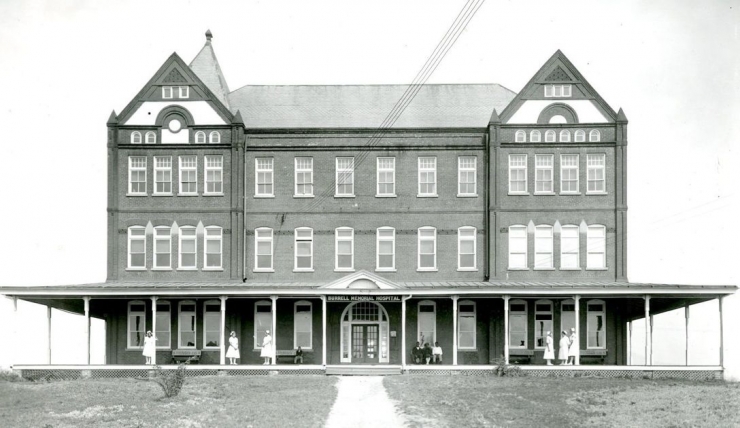
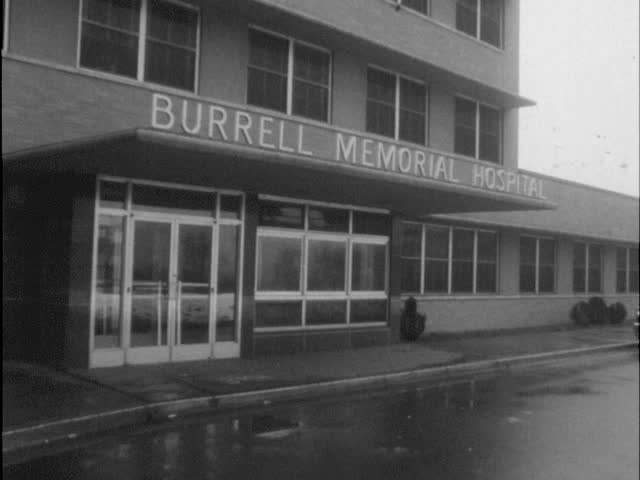
Burrell Memorial Hospital in the 1920s
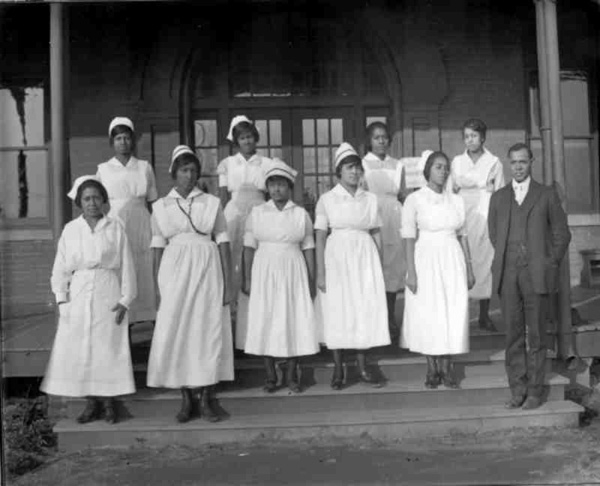
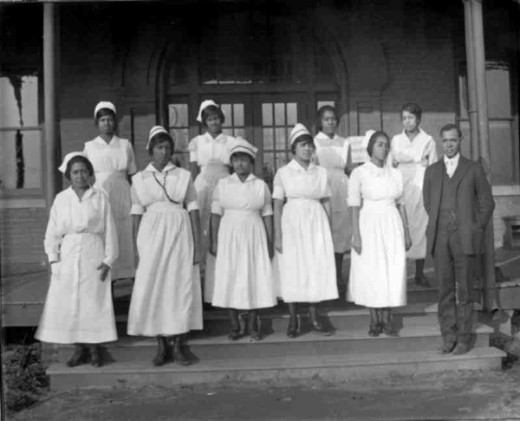
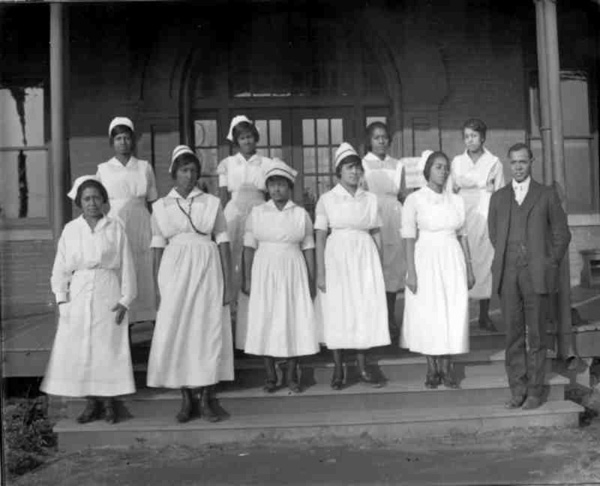
Dr. James H. Roberts and the Burrell nursing staff, circa 1920
GROWING IN THE COMMUNITY
By 1935, Burrell Memorial Hospital had an active staff of six Black doctors, with 20 white doctors as consultants. Physicians from all of the local hospitals had patients and performed operations at Burrell.
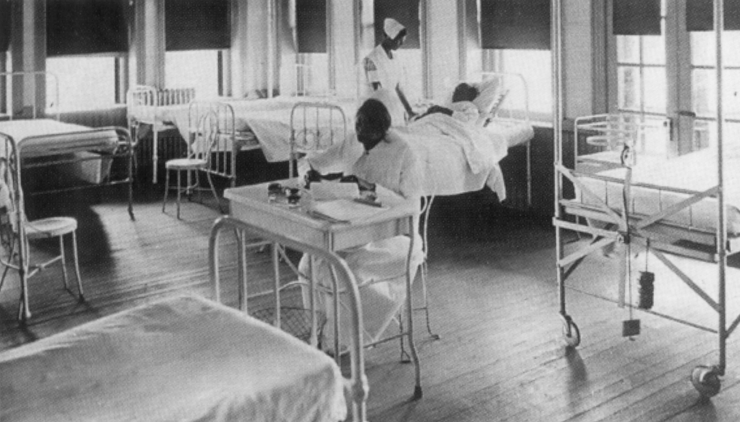
A medical ward at Burrell Memorial Hospital, circa 1930s.
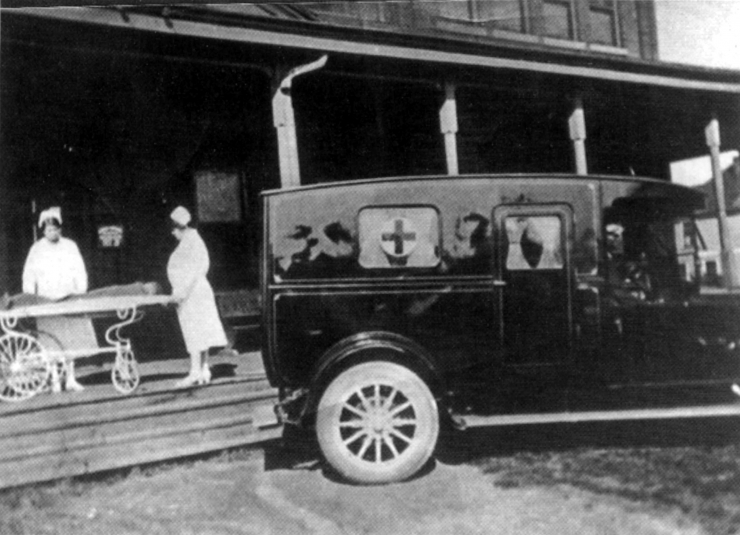
An ambulance delivers a patient to Burrell Memorial Hospital, circa 1930s.
The hospital continued to set ever-higher standards that led to a string of firsts, including a full-time registered dietician, a social worker and a registered medical technician. In 1947, it became the first hospital to be directed by a member of the American College of Hospital Administrators.
In 1950, Roanoke Valley residents pledged $2.1 million for the construction of two new replacement hospitals for Roanoke Memorial and Burrell Memorial.
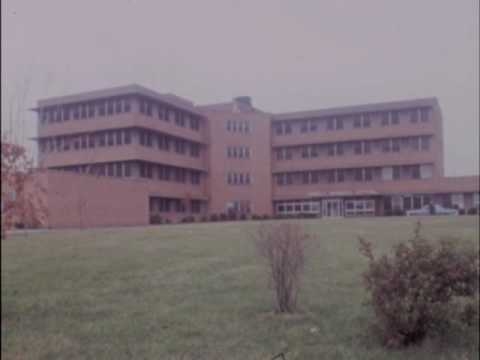
The new, 80-bed Burrell Memorial Hospital opened in 1955. That year, 1,363 people were treated in the outpatient and emergency departments.
CHANGES IN SOCIETY
In the early 1960s, the world was changing from black and white divides to a time of integration. In the wake of the 1965 enactment of Medicare laws and Civil Rights acts, patients began choosing to go to the area hospitals that had opened their doors to African-Americans, or their doctors were choosing to send them to other facilities.
By the early 1970s, only about 45 to 50 patients were being seen a day at Burrell Memorial Hospital, when other area hospitals were at or above capacity. The hospital staff of 16 included the only three Black doctors in Roanoke.
While the building itself was in good shape, it was becoming increasingly obvious that serving as a general hospital was not the answer.
After 63 years of service to the community, in 1978, the hospital--which had risen from the dreams of six Black physicians in 1914 and persevered through immense economic and social challenges--closed its doors.
A NEW PURPOSE
The building was reopened in 1979 as the Burrell Home for Adults. The following year, Roanoke Hospital Association purchased the facility. Roanoke Hospital Association, with Burrell as a subsidiary, grew into a regional health care system in 1988--Carilion Health System.
Blue Ridge Behavioral Healthcare collaborated with us in 2001 to turn the historic Burrell facility into an integrated behavioral healthcare service center.
While we no longer own the Burrell building, its history still plays an important part in the progression of health care in the Roanoke Valley.